
Pearson Square Method Explained: Formula, Diagram, Solved Examples & Uses

If you've ever wondered how food technologists blend two ingredients to create a product with an exact protein, fat, or moisture content without touching a single equation sheet, the answer is usually the Pearson Square Method. It's one of the most practical calculation tools in food and feed formulation, and it also happens to be a favorite topic in the GATE Food Technology syllabus.
This guide walks you through what the method is, when to use it, how to draw and solve it, and where students commonly slip up, with a fully solved example and GATE-style practice questions at the end.
For two ingredients A and B with compositions and , blended to a target composition (where ):
- Parts of A
- Parts of B
- Ratio of A : B
What Is the Pearson Square Method?
The Pearson Square Method is a simple arithmetic technique used to determine the correct ratio of two ingredients needed to achieve a target nutrient or compositional value. Instead of solving simultaneous equations, the method uses a visual square (or "X" shape) and basic subtraction to arrive at the mixing ratio.
It is widely used in:
- Food formulation: blending flours, protein isolates, or fat sources
- Animal feed formulation: balancing protein or energy content in feed mixes
- Milk standardization: adjusting fat or SNF (solids-not-fat) content by blending milk of different compositions
- Flour blending: combining high-protein and low-protein flours to meet baking specifications
When Should You Use the Pearson Square Method?
The method only works under specific conditions. Before applying it, confirm that:
- Only two ingredients are being mixed. The Pearson Square is strictly a two-component tool; it cannot directly handle three or more ingredients.
- A single nutrient or property is being balanced such as protein, fat, moisture, or total solids.
- The desired value lies between the two ingredient values. The target must fall numerically between the compositions of the two ingredients, never above or below both.
If any of these conditions isn't met, the Pearson Square Method cannot be applied correctly, and other methods should be used instead.
The Pearson Square Diagram
The method gets its name from the square (or X) diagram used to organize the calculation. Here's how it's constructed:
- Write the desired composition in the center of the square.
- Place the two ingredient compositions at the left corners. One at the top-left, one at the bottom-left.
- Subtract diagonally. Subtract the center value from each ingredient value diagonally across the square (ignoring the sign), and write the result at the opposite corner.
- The diagonal differences become the mixing ratio. These numbers represent the parts of each ingredient required.
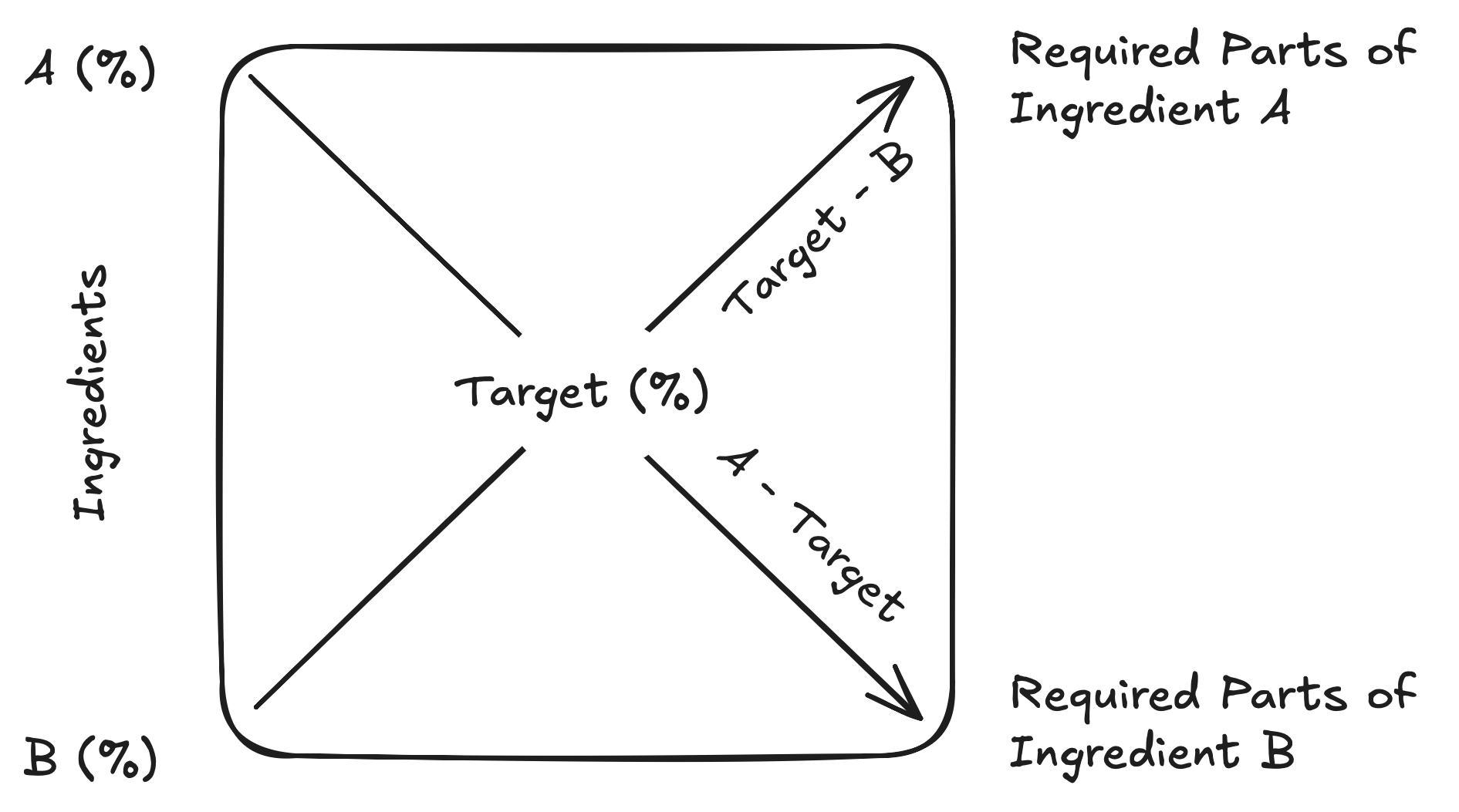
The key rule to remember: each ingredient is subtracted diagonally from the target, and the resulting difference tells you how many parts of the other ingredient are needed — not itself.
The number obtained after diagonal subtraction always corresponds to the opposite ingredient, not the one it's subtracted from. Writing a difference next to the wrong ingredient is one of the most common mistakes in Pearson Square numericals. Double-check this before finalizing your ratio.
Why the Method Works: The Mass Balance Behind It
The Pearson Square isn't just a trick, it's a shortcut for solving a mass balance equation. If you mix parts of Ingredient (composition ) with parts of Ingredient (composition ) to get a target composition , the underlying principle is:
Rearranging this equation shows that the ratio simplifies to which is exactly the diagonal differences the Pearson Square produces. In other words, the "excess" nutrient contributed by the richer ingredient must exactly balance the "deficit" from the leaner one, weighted by how much of each is used. This is why the method only works when the target lies between the two ingredient values and outside that range, the balance can never be satisfied.
Solved Example: Blending Soy Flour and Wheat Flour
Let's apply the method to a real formulation problem.
Problem: You need to prepare a blend with 20% protein using:
- Soy flour: 45% protein
- Wheat flour: 12% protein
Step 1: Set up the square
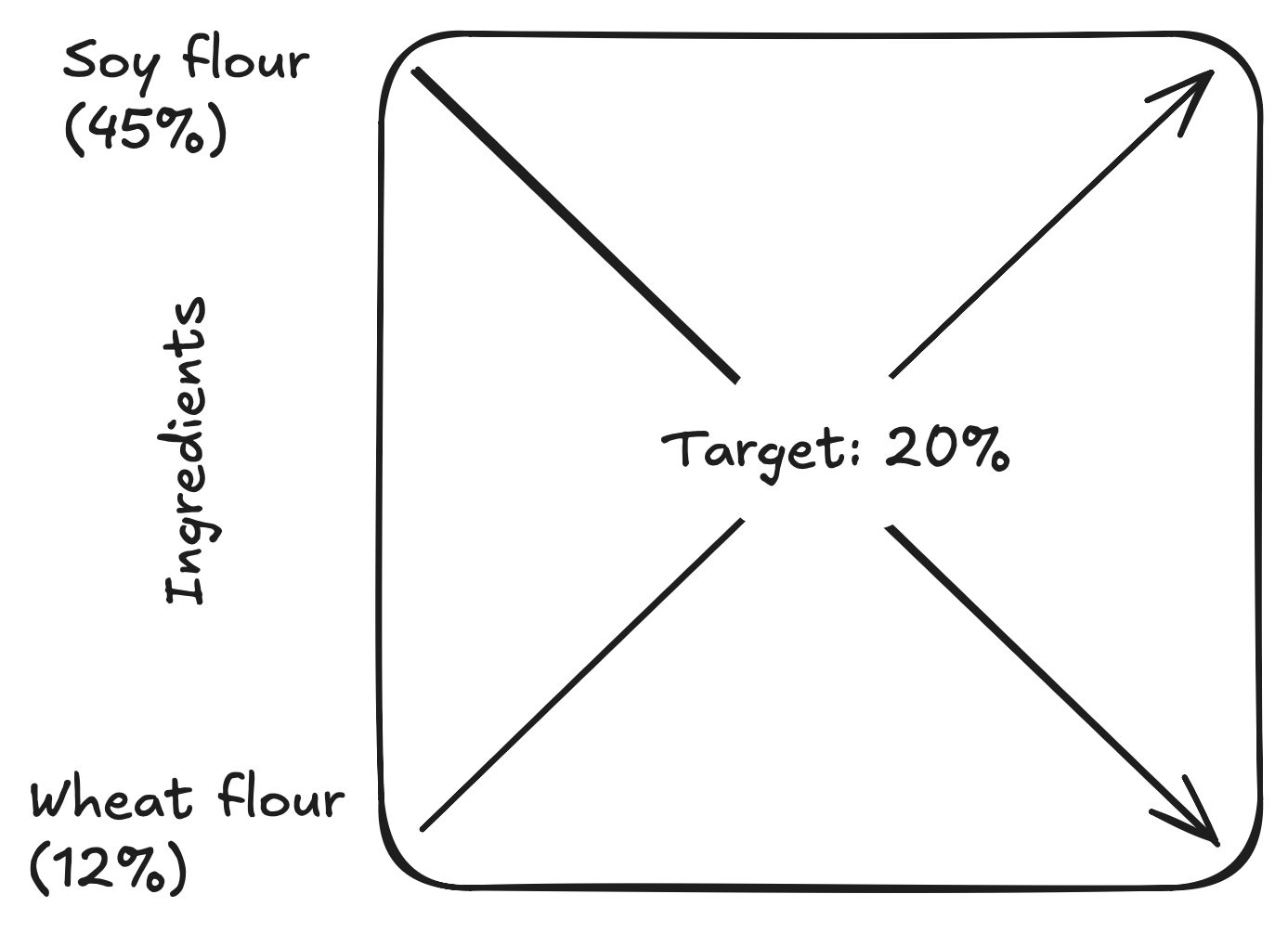
- Center value (target) = 20
- Top-left = 45 (Soy flour)
- Bottom-left = 12 (Wheat flour)
Step 2: Subtract diagonally
- Top-right = |Target − Wheat flour| = |20 − 12| = 8 → parts of Soy flour
- Bottom-right = |Soy flour − Target| = |45 − 20| = 25 → parts of Wheat flour
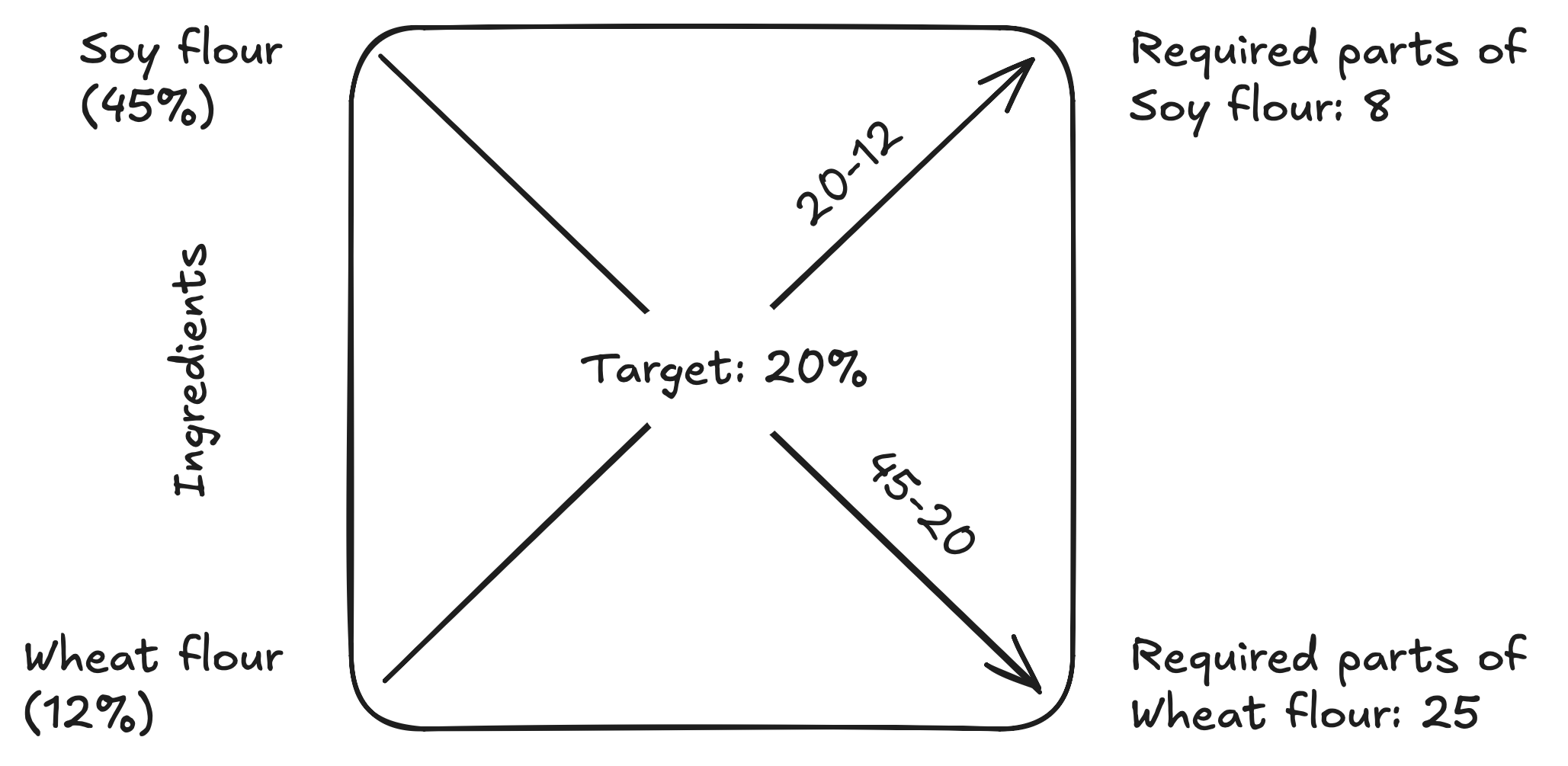
Step 3: Read the ratio
- Soy flour : Wheat flour = 8 : 25
Step 4: Convert to proportions (optional)
Total parts = 8 + 25 = 33
- Soy flour proportion: of the blend
- Wheat flour proportion: of the blend
Verification:
So, to achieve a 20% protein blend, you would mix 8 parts soy flour with 25 parts wheat flour.
Shortcut Tips for Faster Calculations
Keep these practical reminders in mind, especially during exams:
- Always subtract diagonally, never subtract values on the same side of the square.
- Ignore negative signs, use absolute differences only; the Pearson Square deals with magnitudes, not direction.
- The target value must lie between the two ingredient values. If it doesn't, the method breaks down and gives meaningless (negative or reversed) results.
- The resulting numbers represent parts, not percentages. Convert them into percentages or actual quantities only if the question specifically asks for it.
- Double-check by verifying your final blend mathematically (as shown in the solved example).
Common Mistakes to Avoid
Even though the method is simple, these errors are frequent among students:
- Swapping the diagonal differences: Writing the soy flour's difference next to soy flour instead of wheat flour (and vice versa).
- Using more than two ingredients: The classic Pearson Square only supports two-component mixes; three-ingredient problems need other approaches.
- Choosing a target value outside the range of the two ingredients, which produces an invalid or impossible ratio.
- Forgetting to convert the ratio into actual quantities when the question asks for kilograms, liters, or percentages rather than a simple part-ratio.
Limitations of the Pearson Square Method
While convenient, the method has some important boundaries that students should keep in mind:
- Only two ingredients at a time. It cannot directly solve problems involving three or more components.
- Only one property is balanced per square. If a formulation needs to satisfy two constraints simultaneously (say, protein and fat), a single Pearson Square can't do both at once. You'd need a modified approach or simultaneous equations.
- It assumes complete, uniform mixing with no processing losses. Real-world losses during blending, drying, or storage aren't accounted for.
Understanding these limits helps you recognize when a question actually needs a more advanced formulation method rather than a straightforward Pearson Square.
GATE Practice Questions
Try these problems to test your understanding. (Attempt them before checking the answers below each question.)
Q1. A dairy wants to standardize milk to 4% fat using whole milk (6% fat) and skim milk (0.5% fat). Find the mixing ratio.
Answer: Whole milk : Skim milk = (4 − 0.5) : (6 − 4) = 3.5 : 2
Q2. You need a blend with 15% fat using cream (35% fat) and skim milk (0.1% fat). Determine the required ratio.
Answer: Cream : Skim milk = (15 − 0.1) : (35 − 15) = 14.9 : 20
Q3. A blend of 10% moisture is required using ingredient A (5% moisture) and ingredient B (20% moisture). Find the percentage of each ingredient in the blend.
Answer: A : B = (20 − 10) : (10 − 5) = 10 : 5 = 2 : 1. As percentages: A = 66.7%, B = 33.3%.
Q4. A 500 kg feed mixture containing 18% protein is to be prepared from maize (9% protein) and groundnut cake (40% protein). Determine the quantity of each ingredient required.
Answer: Ratio (Groundnut cake : Maize) = (18 − 9) : (40 − 18) = 9 : 22, total parts = 31
- Groundnut cake =
- Maize =
Verification:
Take Your GATE Food Technology Preparation Further
Mastering concepts like the Pearson Square Method is an important step toward scoring well in GATE Food Technology (XE & XL). However, success in GATE requires a structured understanding of the entire syllabus, consistent practice, and regular assessment.
With fyGATE by Foodemy, you'll get everything you need to prepare with confidence:
- 🎥 High-quality video lectures by experienced faculty
- 📚 Crisp, exam-focused study notes covering the complete GATE Food Technology syllabus
- ✅ Solved Previous Year Questions (PYQs) with detailed explanations
- ✍️ Chapter-wise practice questions to strengthen your concepts
- 📝 Full-length mock tests on a dedicated online test platform
- 👨🏫 Expert mentorship and personalized guidance throughout your preparation
- 💬 Dedicated doubt clearance sessions to resolve your queries
- 🤝 One-on-one mentoring sessions to help you stay on track and achieve your goals
Whether you're starting your preparation or aiming to improve your rank, fyGATE provides a structured, comprehensive learning experience designed specifically for GATE Food Technology (XE & XL) aspirants.
👉 Explore the fyGATE Course: https://foodemy.in/courses